
A write-off happens when an insurer decides that repairing a vehicle costs more than it’s worth, or that the damage is too severe to fix safely. That doesn’t always mean the car looks like a wreck. Plenty of write-offs are hail-damaged or flood-affected, with barely a scratch visible from the outside.
A PPSR VIN search is the fastest and most reliable way to check if a car is a write-off in Australia. For $2, it pulls the vehicle’s official write-off record straight from NEVDIS.
Every write-off record on a PPSR certificate uses different codes for incident type, damage location, and damage severity. Once you know how to read these codes, you can understand the write-off history by yourself.
To make it easier, we’ll break each part down below, then walk through two real search results. So keep reading till the end.
How to Check If a Car Has Been Written Off
You can check if a car is a write-off by running a PPSR search using the vehicle’s VIN, not the number plate. It takes about five minutes and costs $2. Here’s the process, step by step.
Find and Verify the VIN
The VIN is the 17-character code stamped onto the car itself, not printed on a rego sticker. You’ll usually find it at the base of the windscreen, inside the driver’s door jamb, or on a metal plate in the engine bay. Write it down, then check it against the rego papers, logbook, and insurance certificate.
If the VIN on the car doesn’t match the paperwork, walk away. That mismatch is one of the biggest red flags of a rebirthed or cloned vehicle.
Run a PPSR Vehicle Search
Head to ppsr.gov.au, enter the 17-digit VIN, pay the $2 fee, and download the certificate. This is the only official written-off car check in the country. A rego-plate lookup through a third-party site gives a rough summary, but it won’t show the full write-off or encumbrance details a proper VIN search does.
The certificate covers:
- Write-off status and damage codes
- Stolen vehicle notifications
- Money owing on the car (security interests)
- Basic specs like make, model, body type and compliance date
Check the Written-Off Vehicle Notification
Scroll to the section titled “NEVDIS Written-off Vehicle Notification.” A clean vehicle simply says “Not recorded as written-off.” If it has a history, you’ll see the state, the date, the write-off category, and the raw damage codes we’ll decode below.
Compare the Result with the Seller’s Information.
A PPSR certificate is only half the picture. Match it against what the seller tells you and what you can see in person. If they insist the car’s never been in an accident, but the certificate shows impact codes, that’s worth questioning before you hand over a deposit.
Understand the PPSR Written-Off Codes
Every damage code on a PPSR certificate follows the same three-part structure: incident type + damage location + damage severity, as set out on the PPSR’s own written-off codes page. Once you know what each part means, a code like I01B stops looking like a random string of characters and starts telling you exactly what happened to the car.
Incident Type: What Caused the Damage?
The first letter tells you what caused the write-off in the first place.
| Code | Incident Type | What it means |
| D | Dismantled | Parts were legitimately removed for resale |
| F | Fire | Damage from heat or flames |
| H | Hail | Hailstone damage |
| I | Impact | Collision with another vehicle, object, or animal |
| M | Malicious/Stripped | Vandalism, theft of parts, or stripped panels |
| W | Water | Flood or water inundation |
Impact (I) is by far the most common code you’ll see, since it covers everything from a minor front-end tap to a serious rollover.
Damage Location: Where was the Vehicle Hit?
The two-digit number that follows tells you which part of the car took the damage, across 46 possible locations.
| Code | Location | Code | Location |
| 01 | Passenger front | 07 | Engine |
| 02 | Driver front | 08 | Roof |
| 03 | Driver side | 09 | Interior |
| 04 | Driver rear | 17/21 | Chassis rails |
| 05 | Passenger rear | 30 | Engine block |
| 06 | Passenger side | 38–40 | Airbags |
Damage Severity: How Bad Was It?
The final letter is the one that actually matters most, because it tells you whether the damage was cosmetic or structural.
| Code | Severity | Category |
| A | Heavy panel | Body |
| B | Light panel | Body |
| C | Heavy structural | Chassis |
| D | Light structural | Chassis |
| E | Unrepairable | Statutory |
| F | Major mechanical | Drivetrain |
| G | Minor mechanical | Drivetrain |
| L/M | Water damage | Flood |
| N/O/P | Fire damage | Fire |
The severity letter changes everything. I01B (impact, passenger front, light panel) is a minor cosmetic repair. I01C (impact, passenger front, heavy structural) means the chassis rail itself was bent, which is a far bigger deal for resale and safety.
How to Read a Real PPSR Write-Off Result
Reading a real certificate is easier once you’ve seen one. Here are two genuine examples, side by side.
Example 1: A Repairable Write-Off
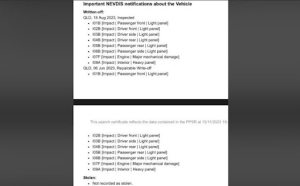
A Reddit user shared this PPSR certificate for a Toyota Land Cruiser, showing a “Repairable Write-off” status. The damage codes tell the real story:
- I01B, I02B, I03B, I04B, I05B, I06B – light panel impact damage across the front, sides and rear
- I07F – major mechanical damage to the engine
- I09A – heavy panel damage to the interior
Panel damage across nearly every side of the vehicle, plus a major mechanical hit to the engine, points to a rollover rather than a single-point collision. This is exactly the kind of result where an independent mechanical inspection isn’t optional; it’s essential.
Example 2: No Write-Off Recorded
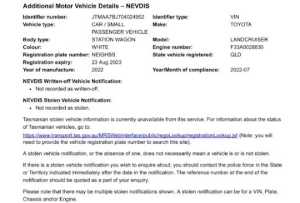
Another user on Reddit shared this PPSR certificate, which shows the vehicle had no write-off recorded. The Stolen Vehicle Notification directly below also confirms “Not recorded as stolen.” Two clean results here are the baseline you want before you buy.
“Not recorded as written-off” doesn’t mean accident-free
A clear PPSR result only means no insurer lodged a total-loss claim with NEVDIS. It doesn’t mean the car has never had a bingle. If a previous owner paid for repairs out of pocket without going through insurance, that history simply won’t show up here.
A PPSR search is a register of write-offs and money owing, not a full service or accident logbook, so it’s still worth pairing it with a visual inspection and, ideally, a vehicle history report from a workshop you trust.
Repairable vs Statutory Write-Offs in Western Australia
In WA, whether a written-off vehicle can go back on the road comes down to which of two categories it falls into, as classified by the Department of Transport WA.
Repairable Write-Off
A repairable write-off is a car where repair costs plus salvage value exceeded its market value, but the structural damage wasn’t severe enough to ban it from the road permanently. In WA, getting one back on the road means:
- Keeping every receipt, invoice and before/after photo of the repair
- Passing a primary inspection at an approved Written-Off Vehicle (WOV) business before any paint or filler goes on
- Passing a secondary roadworthiness and identity check at an Authorised Inspection Station (AIS)
- Fitting an approved engine immobiliser and lodging Form VL17 in person
Even once it’s relicensed, the write-off history never disappears from NEVDIS. Every future buyer, and every future insurer, will see it.
Statutory Write-Off
A statutory write-off is damaged badly enough that it can never legally return to the road, in any state, under any circumstances. According to DTMI’s statutory write-off criteria, this usually applies where structural frame damage spans three or more key areas, fire has blistered paint across multiple structural members, or floodwater has risen above the cabin’s door sill. Its VIN is permanently flagged on the WOVR, and from that point on it can only be sold for parts or scrap.
Being a Buyer in WA, you Should Check
- Ask for full written disclosure of the write-off history, not a verbal assurance.
- Request WOV and AIS inspection certificates if it’s a repaired RWO
- Confirm the immobiliser is fitted and book an independent mechanical inspection
What to Do After Finding a Write-Off Record
Finding a write-off on the certificate isn’t automatically a dealbreaker, but it changes how carefully you need to move.
- Decode every code, not just the first one. A car can carry entries from several incidents.
- Ask for repair evidence, including WOVI clearance, invoices and photos, if it’s listed as repaired.
- Inspect the panels, checking for overspray, mismatched paint, or gaps that don’t sit flush.
- Get an independent hoist inspection so a mechanic can check the chassis properly.
If the numbers don’t stack up, or the seller can’t produce paperwork to back their claims, it’s usually not worth the risk.
Sell Your Written-Off Car to Frontline Auto Wrecker
If your own PPSR check has come back as a write-off, or you’ve simply decided it’s not worth repairing, we buy unwanted and written-off vehicles for cash across Perth, no matter the condition. We’re not a dealer guessing at what happens next; we’re the yard where it actually happens: your car gets assessed, dismantled responsibly, and any usable parts are tested and resold rather than sent straight to landfill.
That’s also where a lot of our stock comes from. If the write-off check on your next car turns something up and you decide to walk away, our tested used parts, many salvaged from statutory write-offs just like the ones covered in this guide, are a genuinely affordable way to fix up whatever you’re driving now.
Whether you’re clearing out a written-off vehicle taking up space in the driveway or you need a reliable used part without paying dealer prices, get in touch with Frontline Auto Wrecker for a straightforward, no-pressure quote.
FAQs
Does a written-off car reduce its resale value permanently?
Yes. A write-off flag stays on the vehicle’s history forever, even after a legitimate repair, which usually lowers resale value and limits future insurance options.
Can I insure a repairable write-off after it’s fixed?
Some insurers will cover a repaired RWO, but often at a reduced value and higher premium. Always confirm with the insurer before buying, not after.
Does a PPSR check show previous accidents not claimed on insurance?
No. PPSR only records insurer-lodged total-loss claims. Repairs paid privately, without an insurance claim, won’t appear on the certificate at all.
How long does a car stay on the written-off vehicle register?
Permanently. Once a VIN is logged on the WOVR, whether statutory or repairable, that record never expires or gets removed from NEVDIS.
Can I get finance on a car with a repairable write-off history?
It’s harder. Many lenders decline finance on repairable write-offs, or offer it only at a reduced loan-to-value ratio, so check with your lender first.